


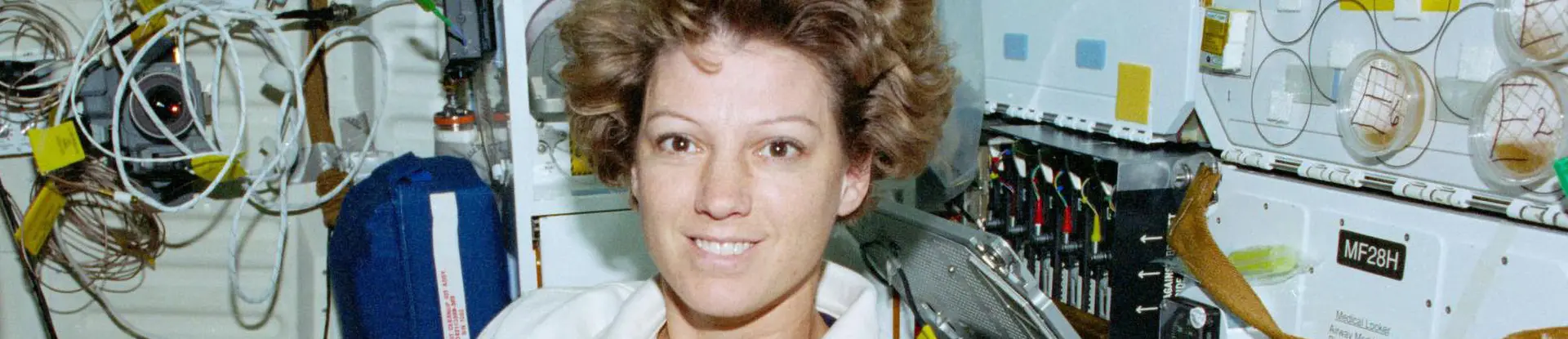
Colonel Eileen Collins, an SwRI advisory trustee and the first woman to pilot and command a NASA spacecraft has been on tour across the U.S. with her new documentary, “Spacewoman.” She stopped into the podcast studio to talk about the film based on her book, “Through the Glass Ceiling to the Stars.” As a NASA astronaut, Collins was part of four space missions, including serving as commander of the Return to Flight Mission following the Columbia disaster of 2003.
Listen now as Col. Collins discusses her path to NASA, the varied effects of space travel on the human body, how she overcame doubts and fears to venture back into space after tragedy and the documentary that dives deep into the darkest and most triumphant moments of her life.
Visit Eileen Collins to learn more about the woman who made history exploring the cosmos.
Transcript
Below is a transcript of the episode, modified for clarity.
Lisa Peña: A new documentary chronicles the life of retired Air Force Colonel Eileen Collins, the first woman to pilot and command a NASA spacecraft. Collins rocketed to space four times. She's here today to talk about her NASA missions, her extraordinary career, and the raw and honest film, exposing vulnerable moments and celebrating triumphant milestones in her life. That's next on this episode of Technology Today.
[MUSIC PLAYING]
We live with technology, science, engineering, and the results of innovative research every day. Now, let's understand it better. You're listening to the Technology Today Podcast presented by Southwest Research Institute. From deep sea to deep space, we develop solutions to benefit humankind. Transcript and photos for this episode and all episodes are available at podcast.swri.org. Share the podcast and hit that subscribe button on your favorite podcast platform.
Hello and welcome to Technology Today. I'm Lisa Pena. The documentary "Spacewoman" tells the remarkable story of Colonel Eileen Collins, recounting her career as an astronaut and as the first woman to pilot a space shuttle during the Discovery mission in 1995, and the first woman to command a space mission, the Columbia mission, in 1999.
But it also goes behind the scenes, diving into her childhood, family life, and the moments that shaped her identity. It's based on her book "Through The Glass Ceiling to the Stars". Colonel Collins serves as an SwRI advisory trustee, and she's here today to talk about her journey to NASA, experiences during her four missions, and her new documentary. Eileen, you have certainly been busy making the rounds across the country for screenings, audience Q&A sessions, TV interviews, so we're so glad you could be here today in our podcast studio.
Image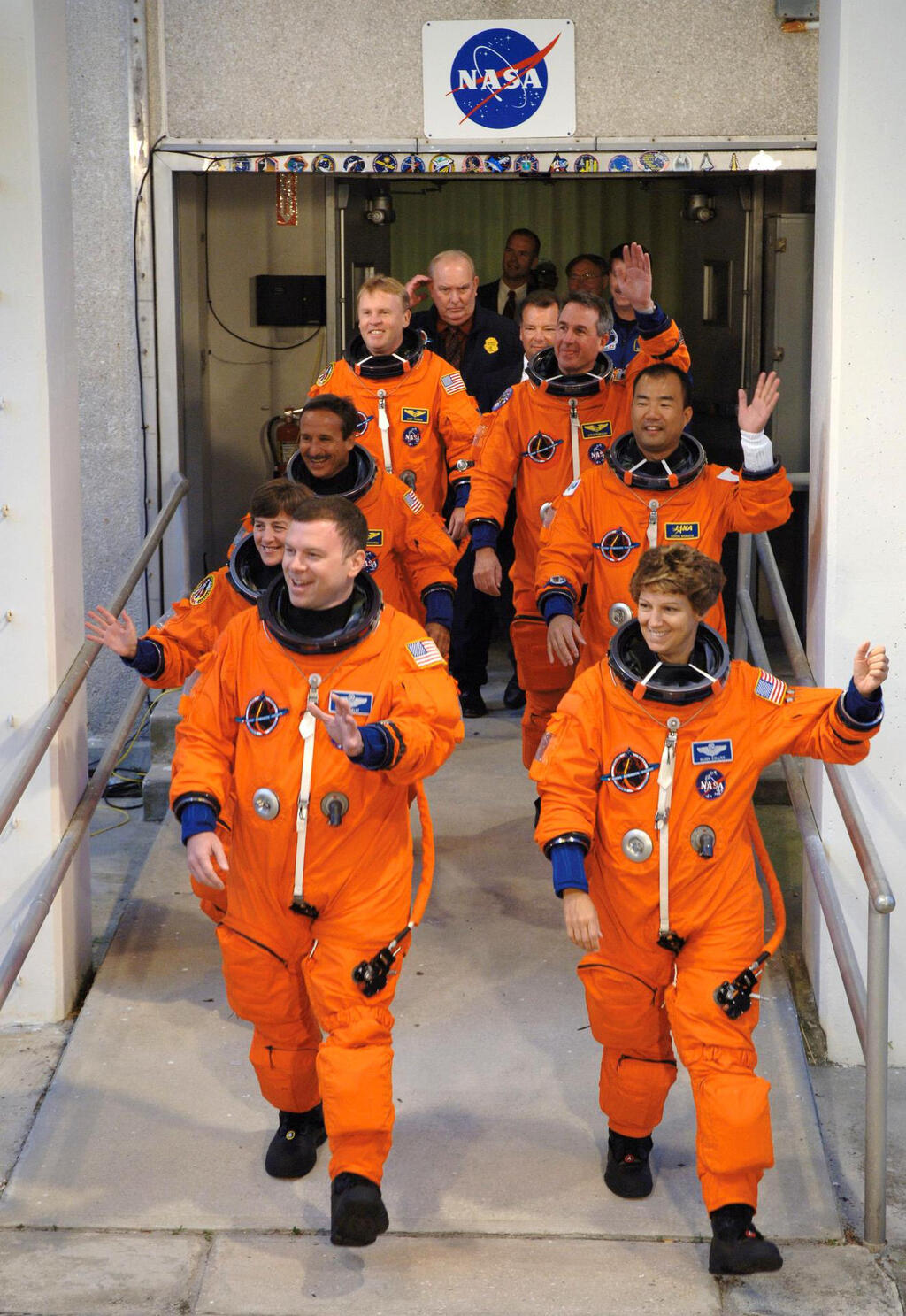 NASA/JSC
NASA/JSC
Col. Eileen Collins, commander, front right, leads the crew of the Discovery Return to Flight mission as they head to a Kennedy Space Center launch pad in July 2005. This was the first NASA mission following the 2003 Columbia disaster and Collins’ last mission to space.
Eileen Collins (EC): Well thanks, Lisa. Thanks for inviting me. Looking forward to talking about "Spacewoman".
LP: We really have so much to talk about today. So I attended a "Spacewoman" screening here in San Antonio, Texas, and your story is truly fascinating. Such an impactful film. Let's start with the big question. What does it feel like to have people watching your life unfold on the big screen in movie theaters across the US?
EC: Well, I'm not really excited about having my life on the big screen. And just to give you some background on how the film came about, a film producer, Keith Haviland; and by the way, just to back up, Keith Haviland has done many movies on space. He did one on mission control. He did one called "The Last Man on the Moon", which is a story of Gene Cernan, who was the commander of Apollo 17. He actually had a documentary on Neil Armstrong. And I had heard of Keith.
Well, he read my book, and it was late 2021. And about a month after my book came out, I get an email from him and he said, I'd like to do a documentary film on your book. And I said, thank you very much, but absolutely not. I don't promote myself. I like to work hard and do my job, and I'm not really into the PR. And some people are. I'm not. And he kept asking me and I said, the reason I said no is it's not just about me. It's my family. It's my coworkers.
We had had a terrible accident. We lost the shuttle Columbia in 2003. I was the commander of the flight right after that. I wasn't sure I wanted that up on the screen out of respect for the surviving family members of Columbia. And also, my family life growing up was very difficult. My dad was an alcoholic. My mom had a lot of issues. My parents split up, and we didn't have a lot of money. I had been on welfare, the family, Medicaid, food stamps, my dad in and out of treatments. I did not want that on the screen out of respect for my family. And so I kept saying, no, no, no.
And about nine months later, I eventually said yes to Keith. And the reason was, my family, my sister and my brother and by the way, my parents are passed away. So my sister and my brother were OK with doing the film. I had asked them about it. And I think it would have came down to Eileen, it's not all about you. Stop making it about you. It's really about the story and about overcoming odds and going on to I've always wanted to be an astronaut. Going on and fulfilling your dream of being an astronaut. Other people need to hear that story.
And from my children, I wanted to make sure that my husband and my children were okay with it. And they were fully on board. In fact, they started encouraging me. You should make the film. Say yes to Mr. Haviland. And so it took about, I'm going to guess, about nine months or so. And I finally said yes, a little bit hesitating, but he had agreed with me that there would be nothing in the film that would be upsetting to family members of my family or the Columbia astronauts' families. And he was true to that.
Now, let me say that everything in the film is true and accurate, and I think it's all respectful. And I think the story came out very well. And in the end, I am just blown away by the result. I think Keith and his team, his director, Hannah Berryman, and he had another producer, Natasha Dack. I mean, the cameraman, the editor, the people that did the music. They did a wonderful job, and I'm very happy with the final product. So I'm glad in the end that I said yes.
LP: And we're so glad you said yes. Having seen the documentary, it is so well done. As you said, so tastefully done. So much insight into your path to NASA. And it's evident that you really had the support of your family going into that. Everyone is remarkable in the documentary. So we want to get back to the film in a moment, but let's get into your background. You told us about your childhood growing up, but what was your path to NASA? How do you go from your background to making it as a NASA astronaut?
EC: Well, when I was a kid, I always loved science. And my mom took us to the library and I would come home with stacks of books. I really was interested in, like any young girl, animals and plants and bugs and a little bit about the physical world. And so science fascinated me because of what we know. And then I got older. I was fascinated by what we don't know.
And I reached a point in my life, I think, as a teenager where I started realizing that adults don't know everything, and there's a lot of things about the world that we still are learning and our curiosity. And so I think I was always a very curious person. And I never really tried that hard in school, which is interesting. I ended up at community college after high school graduation, and I started asking myself, what do I want to do with my life?
And this was 1974 that I graduated from high school at a time when women did not choose to be pilots, didn't choose to certainly there were no women astronauts back then. But I had learned about the Gemini and Apollo astronauts, of course, like everyone did going through school, and I thought they were the coolest guys ever. I wanted to be just like them. Looking at their backgrounds, they were engineers, they were pilots, military pilots. They were test pilots. And there were no women astronauts. I thought, well, maybe I'll marry one of these guys and I can be part of the space program.
But in 1978, NASA hired their first six women. And they were in the first class of space shuttle astronauts. A total of 35 astronauts, six of them were women. I was in college at the time, and that's when I decided I am going to apply to be an astronaut.
Now, the other thing that was going on parallel with was that the military services were opening up flight training to women. And the reason you didn't see women as astronauts before 1978 was that really the pipeline was always military pilots and women were not allowed to fly in the military. That changed, and I was in one of the first classes to go through Air Force pilot training. Became an instructor pilot, a cargo pilot.
I was able to do a great job. I taught at the Air Force Academy in the math department for three years. I went through test pilot school, became a test pilot. So that sort of all led into having the, I'm going to say, the background, not only to be eligible, but to be competitive as an astronaut, which I applied in 1989, and it went from there.
And by the way, people ask, why were there no women shuttle pilots before 1990? There were many women mission specialists, but the reason there were no pilots is really to be competitive as a space shuttle pilot, you needed military test pilot experience. And because the military was so slow accepting women, there were just very few. And for me, the timing worked out. And I think the reason I was the first in the shuttle program was just because of the timing.
LP: So really, the opportunities and your goals, as you said, aligned at the right time and got you there to NASA where you wanted to be. So you've been to space four times. What does it feel like physically to be in space? We all know about weightlessness, but what is something we might not know?
Image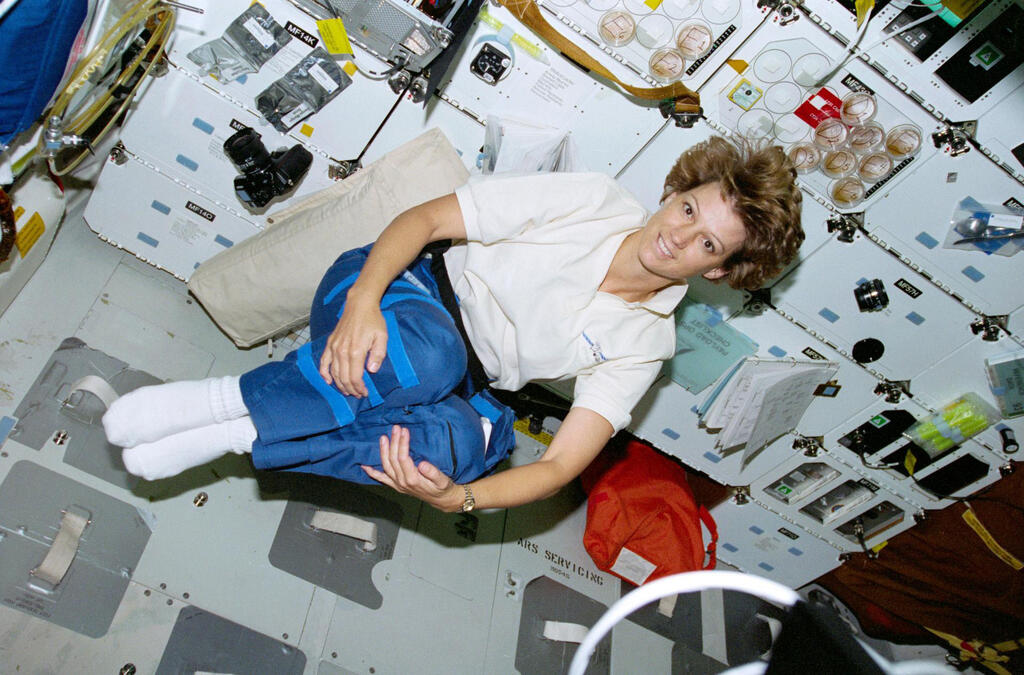 NASA/JSC
NASA/JSC
Astronaut Eileen M. Collins, mission commander, floats on Columbia's middeck during a free moment. She and four other astronauts spent almost five days in Earth orbit in support of the STS-93 mission, the first shuttle mission commanded by a woman. The astronauts deployed the world's most powerful X-Ray telescope and conducted a battery of in-cabin experiments on the first day of the mission.
EC: Well, the first thing that I am thinking of is space tourism will be extremely successful. I believe that the human experience that, I want to say, a human body has in space is so interesting and so different and so fascinating. It's magical. I mean, there's really magical doesn't even go far enough to describe the feeling that you get.
Now, the first day, maybe people do know about this, but really your first minute, five minutes, one hour in space is very uncomfortable. The fluid shift is very uncomfortable. Your face is very fat. Your legs get skinny, which is okay with me. But face gets fat. Your shirt from your suit or whatever you're wearing, just regular clothes, floats up around your neck and your mouth and you start losing things.
And it's almost like trying to roller skate for the first time. How do I get around without being very awkward and bumping into the walls and bumping into switches, bumping into my crew members? It takes a person at least a day to learn how to control your body movements to get around. And then to get really good, it's almost a non-linear experience. You start getting better and better and better at a faster rate. And I'd say for me, after I've been up there about four days, I feel like I can do everything. And some of the long duration astronauts say it really takes months to get fully adapted.
But something people may not know, really, I think people know through hearing the astronauts stories what it's like to go up. But something strange happened to me when I came back down after my first flight. My first night sleeping at home in my own bed, I woke up that morning, and I had lost the feeling in my arms and legs.
The nerves that go into your skin where you feel like when you touch your skin, you feel that you're being touched. And I couldn't feel anything. And no one had told me about that. And I thought, whoa, what is happening to me? I feel like I'm back up in space again. I mean, laying in bed, I couldn't feel the bed. I felt like I was still floating. And I slowly got normal again.
I talked to the flight surgeon about it and he said, oh, some people do have that feeling. It's a little bit eerie. And well, no one ever told me about it. So I started telling the rookie astronauts who went up after me, if this happens to you. And it didn't happen after my other flights. It was just after — maybe very small. So there are some things that, everybody's different, which is why it's important to have many people go up into space, many different people, old and young and different backgrounds, civilians as well as military people. And see, we take data on our bodies, eyes, ears. We take blood samples, urine samples, and we see the changes that happen to the human body. And people are different. Some people have problems.
LP: Okay. A lot of physical changes and effects from being in space. And the second part of that question, what is it like emotionally to see Earth from that perspective? How do you describe that feeling?
EC: Yeah, so emotionally, the first emotion I had was after I was up there for maybe a minute and I was working on my checklist. The shuttle program was very manual as far as doing checklists. Today most things are automatic in the software. I want to say valves and switches and circuit breakers is done by the software today.
But back in the shuttle days, I had to run checklists. I had to shut down the APUs, the Auxiliary Power Units. I had to tie main buses. I had to purge and vent the main propulsion system. Fortunately, that was automated, because if you threw the switches in the wrong order, you could over pressurize and you could cause an explosion if you didn't do that right. So they eventually automated that.
But I was very, very focused. Do this, do this, don't make a mistake. And I looked out the window and the first thought that I had was, look at the Earth. It's really round. And of course it is. You've seen the pictures. You know it is. But when you see it with your own eyes. I'm a pilot. I'm used to seeing a flat horizon. And I looked out and I saw the round Earth, and I'm like, whoa, I'm really here.
And emotionally, I think that I really suppressed any emotions. Part of it was the fact that I was the first woman pilot, and I was always focused on not making a mistake, and I really didn't want the first woman made some terrible mistake. And I mentioned how manual our procedures were, as well as we flew also.
So I was always very focused on — I flew the rendezvous to the Spartan satellite on my first mission, making it the best I possibly could, because part of being the first woman isn't just doing your job. But I wanted to do it better, and I didn't want naysayers to go, oh, look, the woman made a mistake or she didn't do that well. So I was always very, very focused. So I really suppressed any emotions.
My second flight, I was able to have more fun. It turned out my second flight, Susan Kilrain, Susan Still at the time, had also flown as a pilot. So there were more of us at that point in time, and I could just be part of the mission and not worry about trying to prove something, which I hate having to do that, but frankly, that was the world that we lived in back then.
LP: Yeah, that was the time. And it's a lot of pressure to be the first, so that's understandable.
EC: And by the way, I should add to that, looking back at the Earth from space, the closest you can compare that to is some of those IMAX movies that you see in I mean, they made them 20 years ago. We used to take the IMAX camera up on the shuttle with us. The view of the Earth is so beautiful and so overwhelming, and you see the blue and white.
When the sun is shining on the deserts, it's just so bright, especially Australia. In the contrast with the blackness of space, it's really overwhelming when you look at that and you think, oh, wow, we live down there. And you look the other way and you're like, oh, there's really nothing that we know of that's out there in the other direction.
And so I think that the colors, and even at night you see the lightning going off and you can see cities. You can see coastlines because of the high density population on the coastline. Well, you've seen the pictures. You have a very distinct border there of the land with the ocean.
And you always, always see some kind of convective activity around the equator. There's always thunderstorms around the equator. And when the lightning goes off, it kind of goes off in boom, boom, boom, boom, boom. It's almost like it's a sequence of lightning. It's all connected somehow over like thousands of miles.
People need to go into space, and I believe that as the cost comes down and there's more flights, it will get safer. The cost will come down some more, and then people will be able to go into space for a vacation.
Image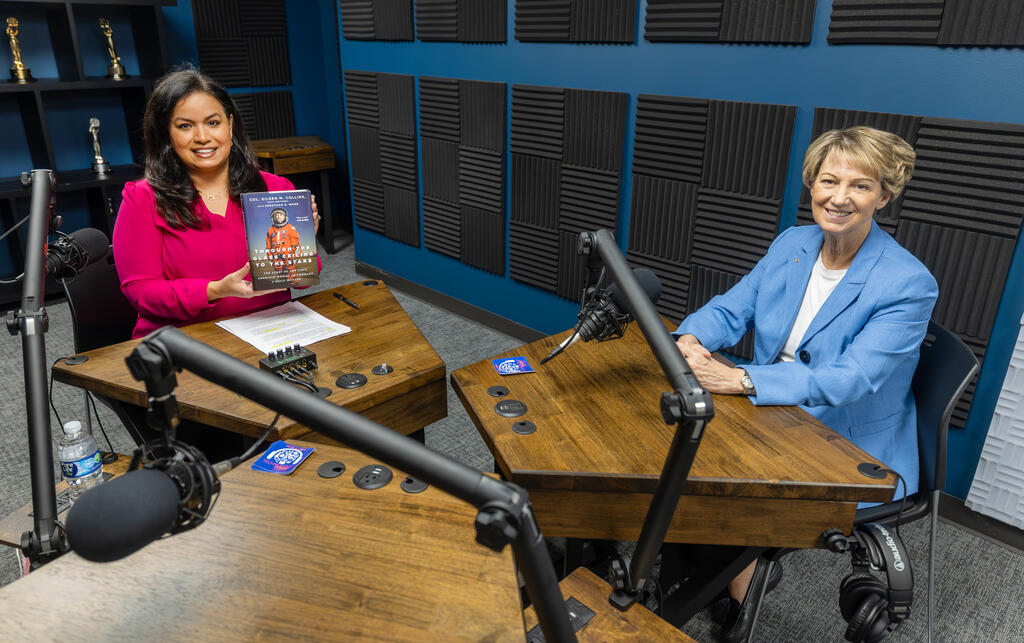
Col. Collins brought podcast host Lisa Peña a copy of her book, “Through the Glass Ceiling to the Stars,” which inspired the new documentary, “Spacewoman.”
LP: And experience the spectacular view for themselves.
EC: Yes.
LP: That's amazing. OK, so as you said, with space travel, commercial space travel, hopefully more people get to experience this. But right now, it's estimated roughly 700, only 700 out of the 8 billion people on the planet have been to space. That's a tiny, microscopic fraction of Earth's population. So how does it feel for you to be in this ultra elite club of space explorers?
EC: Well, I never would have imagined it when I was a kid. In fact, I never told anyone I wanted to be an astronaut. I decided in fourth grade I wanted to be an astronaut. I would not tell anyone, because they would have laughed at me or said, oh, you can't do that or are you crazy or something. Or maybe just a cute little kid, get out of here. So I never told anyone. Back in those days, there were maybe just a couple dozen people who had been in space.
I wish space travel or the opportunities to fly in space had come along farther than it has today. I think it's gone slower than I would much, much slower than I would like to see. That is mostly because of the high cost of space travel. It's even much more expensive having to send people because all of the extra systems.
I mean, you have to keep people alive with oxygen and water, et cetera, but you also have to send food. You have to be able to handle the waste, the garbage. It's difficult and it's expensive. I never thought that I would be part of that mission myself.
But let me say that in this country, I can speak for the US, and there's a few other countries out there too, that you can say, I have this dream to do something really crazy, and you can actually do it. And the opportunities we have here in the United States for education and for hard work and for ideas, honestly, using your imagination and having great ideas and then saying, I think I'm going to try to do this crazy thing. And if you work hard enough, you can actually make it happen.
I read a book one time on Thomas Edison. He was an inventor from long, long, 1800s. And I read about — I was a little kid. I read about how he failed and tried again and tried again and tried again. And I think stories like that, maybe in the back of my mind somewhere, made me try to do things that were kind of maybe crazy. I think I'll try to be an astronaut, because that's what my dream is. So here we are. I guess I can't believe it actually happened. I still can't believe it actually happened.
LP: Living proof that dreams come true. I love that. And you didn't just make it happen. You have visited space four times in your career. So my next question. What is it like to come home? You did talk about that a little bit with the physical sensations that can occur. But obviously you're happy to be back safely, but is it difficult to get reacquainted with daily life, transition back into the mundane tasks of living?
EC: Yeah, so that's a great question, because I think yes and no. And I think it depends on the person and the situation. Buzz Aldrin, who he was on Apollo 11, he was the second man to walk on the moon, wrote a book called "Return To Earth", and he had a difficult time readapting to Earth. Some people do.
I think now that more and more people have flown in space, it's a little bit easier to come back and adapt, because as an astronaut, you come back to work the next day after being up there. You go in the office. Normally it's medical. You go in and you do medical stuff for a week. But you go in the office and the people in the office, well, more than half of them have been in space themselves. So it's like you're not any different from them. So it's a little bit easier today, I think, than in Buzz Aldrin's day.
But I will say the change that I experienced was because I had actually been in space and kind of, I want to say, achieved my dream of getting up there and what a wonderful experience it was, I'd say I became a different person. I wasn't quite as anxiety. I want to say anxiety wasn't part of my everyday.
LP: Personality.
EC: Work, work, work, da, da, da, just always doing things and trying to complete the mission and all of that. I came back and I was like, oh, I've been there. What do I do now?
And I remember driving into work, the first day I'm driving into work after being back from my mission. Some guy cut in front of me on the highway and it was kind of dangerous. Like, boom, he cut in. It was rude. And I thought, I don't care. I'll just slow down and they can all get ahead of me if they want. That's just one example. It was like I just kind of chilled out a lot. And I think I'm still like that.
I was a little bit of an autocrat type person at work. You have to do it this way, this way. And I've learned that's not how you get things done. You slow down, listen to people, and maybe your way is not the only way. I think I just kind of chilled out a lot after. I'm not sure why that is.
LP: Maybe once you saw the big picture, you took a step back. Saw Earth for what it is.
EC: Yeah, I'm not sure. I really am not sure why that is. I had not had children yet. I was married. But I came back and my husband, he's an airline pilot, so he went back to work, and I'm kind of back in my typical routine. After I had children, my second flight, I came back and my daughter was a year and a half. I went right back into the mom mode.
LP: No breaks.
EC: I mean, naps and diapers and taking care of her. I went right back into the mom mode. So I think it's a little bit easier today to readapt to coming back to Earth.
LP: So shifting gears a little bit, the NASA tragedies, the Challenger and the Columbia disasters are covered in the documentary, as you mentioned at the top. How did you overcome the reality that being an astronaut can be dangerous work, especially after you had your children? What motivated you to push beyond any doubts or fears?
EC: So I think the answer to that question goes back to my military roots. As a pilot, I was 21 years old when I went through Air Force pilot training. The times I was at Vance Air Force base, we had several ejections and the crews came down safely. And we had two accidents in particular, where two of our pilots died.
In many of those cases, there was a reason to avoid those accidents, for a variety of reasons. And I think I developed, throughout my time as a pilot, I developed a, oh, those things happen to other people. They don't happen to me. They don't happen to my crew. We have control over what we do and what our mission is. Although the real truth is you don't have control over everything.
But I think I had this maybe a false sense of security of those accidents happen to other people. They don't happen to me. Think about yourself driving a car around the highway here in whatever city you live in. And you just think the accident is not going to happen to me. It happens to somebody who maybe they're going too fast, or maybe they're not checking the rear view mirror or something like that.
So I think it has something to do with a false, I'm going to say, confidence. But you know in the back of your mind, it's a false sense of confidence. But the odds were you're going to be okay. The odds were with us. We saw what happened with Challenger. They had the burn through on the O-ring. Well, that problem was fixed.
And then we saw what happened with Columbia. They had a breach in their heat shield. There was a crack or a hole or whatever. We never saw it, but we know there was a breach in their heat shield. And of course, the wing broke off in Columbia. That was the cause of that accident. We said, oh, we're going to fix those problems. We're not going to fly again until all these problems are fixed.
So I think it was a combination of those two. The confidence that you have. And I could go into a whole theory on this. We don't have time for that. But there's a whole theory on near misses. When you go through flight training, you have near miss, near miss, near miss, which I've had a lot of near misses. Like, oh, yeah, I made it those near misses, and then your confidence goes up. And then, of course, then there's the studying, the accidents and fixing the problems from the past.
Let me say one other thing that's really important. The mission that we are doing is worth the risk that it takes. So we are exploring space. We're learning how to get people off planet Earth, living in space, eventually living on the moon, living on Mars. That is important for humanity. And if we all decide, I'm just going to stay here at home and live in my nice, comfortable home and never go out and learn anything new, that's not good for humanity. In fact, that's not even the human spirit. We are explorers. And we go out, we take calculated risks.
And there's an old saying. Laura Clark, who was on the Columbia, who unfortunately lost her life, she had a plaque in her office. She was a Navy officer. And the plaque said, if I remember this correctly, and it might be an exact quote, it goes like this. A ship is safe in the harbor, but that's not what ships are made for.
And she had that quote in her office. And she was an explorer in her nature also. And I think that's who we are as humans. And we're going to keep exploring even if we continue, God help us we don't have any more accidents, but we will continue to explore.
LP: Takes guts and takes vision. OK, so you famously commanded the return to flight mission, and that must have been scary, for lack of a better word. But it was the first flight after the Columbia disaster and a problem cropped up. So could you explain the issue you tackled and how you solved it?
EC: Yeah, this is really important, and I want to thank Southwest Research Institute for being part of the return to flight mission. It was February of 2003. So yes, it was a long time ago, but the lessons are still worth learning about. So we lost Columbia. And as I mentioned, there was a breach in the heat shield. We lost Columbia.
My crew was the next one scheduled to go up five weeks later, and I was the commander of that flight. It was going to the Space Station. Well, I knew we weren't going to be flying in five weeks. It was going to be years before we get the shuttle flying again.
The part that Southwest Research Institute played is in support of the NASA, and the accident board set up a ground test apparatus, which was a space shuttle wing. We thought that the cause of the breach in the heat shield was some foam that had fallen off of the fuel tank, came down and hit the wing on ascent. And that was true.
So here what you see here in San Antonio, what you set up was it was like a gun that was firing pieces of foam at a space shuttle wing. People thought that foam could not — people. I'm going to say some of the engineers thought that there's no way foam could break a heat shield. It's just too light. It's like picnic basket foam. It's extremely lightweight. But if it is going fast enough, yes, it can do damage. So you fired these out of some type of gun. I forgot what they called it. Fired these pieces of foam at the wing and blew a hole in that space shuttle ground test wing.
And I remember the next day, back when we had the Houston Paper paper, the paper shows up at my house and it said "The Smoking Gun" was the title. So the smoking gun was, yes, the foam can put a hole in a heat shield. And I want to thank Southwest Research for doing that testing.
Well, the question you asked me was about the flight that we eventually went up on the next flight, which was two and a half years later. As the commander of that mission, I had to have confidence that foam was not going to fall off that fuel tank again.
Secondly, if it did fall off the tank, it wouldn't hit us. But if it did hit us, we could see the damage, because Columbia had no way to see their damage. And then do we have a repair method? And if we can't repair it, do we have a rescue space shuttle that could come and bring us home?
I was happy with all of the procedures that we put in place to keep my crew safe. Well, guess what? A piece of foam fell off my launch from a different part of the tank. And so we actually failed in fixing the foam problem, which is why we will never again, I say we. Spacecraft designers will never again design a spacecraft where the heat shield is exposed to falling debris.
Because I will tell you, space launches will always have stuff falling off of them. If you watch a launch close up, you see stuff falling off of the rocket. I mean, little pieces of ice, little pieces of foam, little pieces of debris. We must keep heat shields up on the top where they're protected. So the space shuttle design is, although it was very versatile, it was also very risky.
So I think that's how I'd answer your question. I felt that we had fixed all those problems, but we had not. The shuttle was after my flight, it was grounded for a year again. And they fixed the area where the foam had fallen off on my flight. I'm not going to go into all of those details.
LP: So the documentary covers this extremely well. And really, that's, I would say, a highlight of the film is seeing how that was tackled in space, how that was solved. So anyone thinking about going to see it should definitely go, especially for that maneuver. There was so much that happened.
EC: Yeah, we designed the rendezvous pitch around maneuver. That was a great idea that came out of one of the engineers in the rendezvous section. I went to that meeting where that idea was pitched. And the idea just briefly was we approach the Space Station. When we get to 600 away, we stop, we flip the shuttle around, basically do a 360 degree pitch maneuver in the pitch axis. So it's nose up.
And while we are flipping the shuttle around, which took six minutes to do that whole maneuver, the crew on the Space Station would take pictures of our heat shield to see if there was any damage. That turned out to be extremely successful, and I love the idea. There were some people that were naysayers that you can't do that. I thought it was a great idea. We developed it in the simulator with the engineers, my crew, our supporting astronauts.
And the rendezvous engineers developed that maneuver, the orbital mechanics of it, the procedures, all the little what rates, what velocities, what vectors do we use, and all of that. In two years, I believe we had developed a perfect maneuver. And not only did we do it on my flight, but every flight after mine that went to the Space Station did this RPM rendezvous pitch maneuver.
And so that comes out in the film. I really love the way they had the music going and the camera click, the lenses clicking in the video and the pictures. Considering the people that made the film are not engineers, they are filmmakers, they did a beautiful job.
LP: I mean, they really did.
EC: Even NASA didn't depict it that well.
LP: For those of us who were not as familiar with what transpired on that mission, it really brought it home and painted an astounding picture. So yes, the documentary was top notch in explaining that entire scenario.
So I want to talk about your book briefly. The film is based on your book, "Through the Glass Ceiling to the Stars", which you brought me a copy today and I'm so excited to dive into. So what inspired you to write your story?
EC: The pandemic.
LP: Oh, Okay.
EC: So in March of 2020, I had retired from NASA in 2006, and I was out doing other things. And I was staying busy, didn't have time to write a book. I had authors writing me saying, let's write a book together. I'm like, no, I don't want to write a book. I have my family. I'm busy.
Well, when the pandemic hit in March of 2020, all my travel canceled. I was sitting at home. All my meetings were well, we started meeting on Skype and we ended up going through on Zoom for most of our meetings. And I was just getting bored.
And so I contacted Jonathan Ward, who over the years had been kind of bugging me to write a book. He's an author himself. He had written three books on the space program before he co-authored with me. I said, Jonathan, I think I'm ready to write the book. So we started in April of 2020. It took over a year to write the book.
And we had a literary agent, James Hornfischer, which, by the way, you should look him up. James Hornfischer, Jim Hornfischer, is a historian. His expertise is World War II, the war in the Pacific. And he helped us get a publisher, Skyhorse. And by the way, Jonathan wrote the proposal while I was writing the book.
We sent the proposal to 13 publishers, and they all turned us down. So get ready to be turned down by a publisher. So Jim Hornfischer got us Skyhorse by helping us get the story to them that, hey, it's worth it to do this book. So I'm glad that Skyhorse published it. They did a really good job with it, I think. So I think that's what motivated me.
And the book actually turned out really well. Everything in the book is accurate. I made sure Jonathan researched everything to make sure that we didn't embellish any stories. That all really happened.
LP: And from the book came forth the documentary. And you've been touring with the documentary, going into these screenings, answering questions afterwards. What have you enjoyed most about touring with the documentary?
EC: Well, I enjoyed the people the most. I really, first of all, let me say I've lost my voice three times doing all this talking, going around.
LP: You've been busy.
EC: I'm not sure why that's happening, but fortunately I have my voice back today. I enjoy meeting the people. And after a certain number, I can't do all of the films, obviously, but after a certain number in major cities, we would go up and do the Q&A. And then I would stick around and sign people's books afterwards, take pictures. And I think hearing the questions from people, it's really kind of fun. So I would say the people is the answer to that.
LP: All right. When you look back at your career, the book, the documentary now, is it possible to name what are you most proud of?
EC: Well, I'm most proud of my family, without a doubt. Although I flew four missions in space, I was able to stay married through it all and have two children and raise two children that are now out of the house and on their own. It's very challenging to raise children. I don't care if you're working or staying at home. It's very challenging to raise kids. You have to set boundaries on your kids. You can't let them do whatever they want to do, or your life is going to be out of control.
So I like to tell people that the best training to be a space shuttle commander is to be a parent, because you really learn how to set boundaries and do things that are realistic and keep people focused on, in the case of space flight, stay focused on the mission. Don't let people run around and do things that aren't mission centric. And with the family, keeping my kids, I want to say, grounded with good values and not giving them everything they want.
And I always tell my kids, if I gave you everything you wanted right now, what would you have to look forward to when you grow up? They're like, Mom, Mom. And so I'd say my family is — the astronauts all have families. Not everyone has children, but everyone has extended family. And it's really important that we take care of our families, especially in such a high stress job.
LP: And your family is prominently and beautifully featured in the film. So they were a great asset to your story as a whole. OK, well, how can people buy your book and see your documentary?
EC: Well, so the book is available on Amazon and it's published by Skyhorse. You can also buy it at Barnes & Noble. Sometimes I walk through there. I see the paperback version in Barnes & Noble. But Amazon and Skyhorse are the most common places.
And the documentary, let me say that although we're still in theaters now, it is going digital in June. Now, the date has not been announced yet, but digital meaning you can buy a copy of it. They don't make DVDs anymore for most of these films, but you can buy a digital copy in June.
In July, it is going to streaming. We haven't finalized those contracts yet, but it will be Amazon, Apple, and some other streaming. It's not going to Netflix. There will be some other streaming services yet to be determined. So this is July of 2026 you'll be able to see "Spacewoman".
LP: All right. So this summer, available to buy and stream. And yeah, I highly recommend this documentary. It was intriguing, fascinating, just an all around great story to watch. And your official website is eileencollins.com. That's E-I-L-E-E-N-C-O-L-L-I-N-S dot com to learn about all things Colonel Eileen Collins.
Well, if you are intrigued by space exploration, again, this is a must see film, a must read book. And Eileen, thank you for making time for SwRI during your very busy media blitz. We are proud to call you an advisory trustee. And congratulations on all you have accomplished as an astronaut, now an author, and subject of this intriguing documentary.
EC: Well thanks, Lisa.
And thank you to our listeners for learning along with us today. You can hear all of our Technology Today episodes, and see photos, and complete transcripts at podcast.swri.org. Remember to share our podcast and subscribe on your favorite podcast platform.
Want to see what else we're up to? Connect with Southwest Research Institute on Facebook, Instagram, X, LinkedIn, and YouTube. Check out the Technology Today Magazine at technologytoday.swri.org. And now is a great time to become an SwRI problem solver. Visit our career page at SwRI.jobs.
Ian McKinney and Bryan Ortiz are the podcast audio engineers and editors. I am producer and host, Lisa Peña.
Thanks for listening.
[MUSIC PLAYING]
The new documentary, “Spacewoman,” tells the remarkable story of Eileen Collins, a former astronaut and retired U.S. Air Force Colonel. Collins became the first woman commander of a U.S. spacecraft with shuttle mission Columbia in 1999, the deployment of the Chandra X-Ray Observatory. Her final space flight was as commander of Discovery in 2005, the Return to Flight Mission after the tragic loss of Columbia.
How to Listen
Listen on Apple Podcasts, or via the SoundCloud media player above.